


1 INTRODUCTION
The heating and cooling sector, which accounts for 50 % of global energy consumption [1], plays a pivotal role in this transition. Reducing the energy consumption for heating by 50 %, which is technically feasible, would have a greater impact than if all global road transport achieved zero energy consumption, which is clearly impossible for road transport. One of the potentials is seen in phase change materials (PCMs). They enable efficient thermal energy storage by absorbing and releasing heat during phase transitions, allowing load shifting, peak demand reduction, and cost savings through the use of off-peak or renewable energy, enhance overall energy efficiency by stabilizing thermal conditions, reducing active heating and cooling requirements, and providing reliable thermal buffering across a wide range of applications and temperature ranges [2-4].
Even though refrigerators and freezers may seem to have low power consumption, their mode of operation and worldwide distribution add up to a high electricity demand. The International Institute of Refrigeration estimated more than 2 billion operating refrigeration units in their 2019 report [5]. Therefore, a small increase in the performance of these appliances yields enormous energy savings. Most ideas for improving the performance of refrigeration systems fall into the following categories: (i) development of energy-efficient compressors, (ii) improvement of thermal insulation, (iii) enhancement of heat transfer of heat exchangers, i.e., condensers and evaporators, (iv) advanced control and operation strategies, (v) refrigerant and lubricant selection and (vi) optimized refrigeration cycle and system architecture.
Household refrigerators and freezers usually operatie intermittently by a simple on/off control. The use of variable-speed compressors (VSCs) would allow the transition to a continuous operation. This would decrease mechanical friction and throttling losses in the compressor, increase the evaporator temperature, and decrease the condenser temperature. Improvements of thermal insulation are limited. Currently, polyurethane is mostly used as an insulator in the refrigerator, and even though the thermal conductivity of polyurethane boards is very low, a large quantity of heat is gained even at optimum thickness. It is possible to further reduce heat gains from the walls of a refrigeration system using vacuum insulation panels (VIPs). VIPs are very resistant to the heat transfer, more specifically, about 4-times the thermal resistance of a polyurethane board of equal thickness. Both VIPs and VSCs are very promising technologies, unfortunately due to higher cost, their use is limited to specialized appliances only.
The maximum efficiency of refrigeration processes is determined by the temperatures of the evaporator and condenser. A 1 K increase in evaporator temperature usually results in a 3 % to 4 % reduction in power consumption, and a 1 K reduction in condenser temperature reduces power consumption by 2 % to 3 % [6]. Enhancement of heat transfer from heat exchangers can be achieved by larger evaporator and condenser surface area by adding fins. Alternatively, fans also enhance convective heat transfer, however, their own power consumption must be taken into account.
Another possibility that has attracted much attention in recent years is the use of PCMs, which can absorb large amounts of heat at a nearly constant temperature and are therefore particularly suitable for heat storage. Because of the high potential for increasing the efficiency of refrigerators, this work presents PCMs and their possible use in refrigerators.
To provide broader context for the present review, Fig. 1 compares publication activity in three representative PCM application areas based on a search in ScienceDirect database search for the last 10 years, performed on April 25, 2026: refrigeration applications (−21 °C to 7 °C), domestic heating applications (20 °C to 60 °C), and industrial waste heat recovery (> 80 °C). The comparison is intended to illustrate general research trends. Although PCM technologies have been widely investigated across multiple temperature ranges, refrigeration-related applications remain comparatively less represented, particularly in review literature. This highlights the continued need for focused assessments of PCM integration in cooling and refrigeration systems.[/vc_column_text][/vc_column][/vc_row]
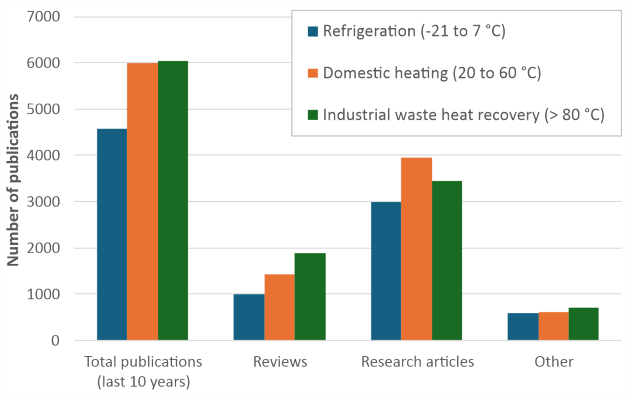
Fig. 1. Comparative publication statistics for selected PCM application areas based on a ScienceDirect database search
While previous reviews [7-13] provide a comprehensive overview of PCM applications in refrigeration systems, this work builds upon both earlier and recent studies to provide a structured, system-level analysis of PCM integration strategies and their practical implications. Rather than focusing solely on newly published studies, this review emphasizes a unified comparison and interpretation of existing results across different system configurations. The main contribution of this review lies in three aspects:
(i) A consistent and comparative analysis of PCM integration across different locations within the refrigeration system (evaporator, condenser, compartment, insulation+PCM and combined configurations), which is not systematically addressed in previous reviews;
(ii) A system-level perspective focusing on practical performance metrics such as compressor cycling behavior, temperature stability, and operational trade-offs;
(iii) An updated overview of commercially available PCMs within the relevant temperature range, highlighting the current state of practical implementation.
In addition, while earlier studies form the foundation of this field, we have also incorporated recent literature to reflect ongoing developments, particularly in system-level evaluation and material availability.
In section 2 PCM materials, their classification and properties are presented. In section 3 state-of-the-art PCM placements at different locations in the refrigeration system are described, as well as their advantages, disadvantages and working principles. Sections 4 and 5 outline the discussion and conclusions, respectively.
2 PCM MATERIALS FOR COLD THERMAL STORAGE
Almost any substance can serve as a PCM, as long as it can undergo the phase transitions when the external conditions in the application are met. In other words, phase change temperature of PCM should be suitable for the process in which PCM is used. However, certain physical, chemical, and economic properties are desirable for the PCM [7]. Table 1 gathers the most important physical, chemical, and economic properties that should be considered when selecting the appropriate PCM. While conventional PCMs are widely used in CTES applications, there is growing interest in exploring sustainable bio-based alternatives, derived from biomass and bio-waste materials [14-16].
Table 1. Important desired (required) physical, chemical and economic properties of PCMs
| Physical properties | Chemical properties | Economic properties |
|---|---|---|
| suitable phase change temperature | chemically stable | price-performance |
| completely reversible freeze/melt cycle | low vapor pressure | abundance |
| high enthalpy change | compatibility with other material | recyclability |
| high specific heat capacity | non-toxic | |
| high thermal conductivity | non-flammable | |
| low supercooling | ||
| low phase separation | ||
| low volume change | ||
| Small temperature glide during phase change |
An additional desirable property is a small temperature glide during phase change. Some PCMs, particularly mixtures, undergo phase transition over a temperature range rather than at a single temperature. While this may be acceptable in applications with broader temperature tolerance, it can negatively affect performance in refrigeration systems where stable and well-defined temperatures are required.
As already mentioned, a suitable phase change temperature must absolutely be fulfilled in order to be able to use the material as PCM at all. A high enthalpy change allows the material to store/release a large amount of energy during the phase change. Similarly, a high specific heat capacity allows the material to store/release large amounts of energy during heating/cooling of the material. High thermal conductivity of the material is important, because it allows faster heat transfer from the system or environment to PCM, resulting in faster responses. Thermal conductivity of PCM can be improved by fabrication of PCM composites, e.g. by adding nanoparticles, metal foam, or expanded graphite into pure sub- stance.
Supercooling refers to the phenomenon where a liquid is cooled below its equilibrium phase change temperature without immediate solidification. This results in delayed nucleation and can significantly affect system performance by lowering the effective operating temperature. In contrast, material hysteresis describes the intrinsic difference between melting and freezing curves of a PCM (Fig. 2), independent of supercooling effects. In practical systems, once nucleation occurs, the release of latent heat often causes the temperature to increase toward the equilibrium freezing temperature. A high degree of supercooling can be reduced with suitable nucleating agents.
Phase separation (segregation) worsens heat transfer inside the PCM and is therefore undesirable. Gelled or thickened mixtures can partially eliminate the phase separation problem. Large volume changes due to phase change are unwanted because they can cause bursting of the container in which PCM is stored. Alternatively, PCM encapsulation provides the ability to store the material in smaller, separated parts, making it easier to control volume changes of PCM. Other advantages of encapsulation include a large heat transfer surface area and reduced risk to the environment in the event of a leakage [17]. The density of PCM is also important; however, it depends on design conditions, whether mass or volume is the limitation. Usually, high density means high heat of fusion per unit volume and low heat of fusion per unit weight [18].
PCMs should be chemically stable and should not degrade over time or due to phase change in order to ensure a durable process. In addition, a low vapor pressure is desirable [7]. In the case of corrosive PCM or other types of incompatibilities with other materials, encapsulation of PCM in chemically neutral (inert) material should be considered. Non- toxic and non-flammable PCMs are desirable in terms of low impact to the environment and the customer. In addition, recyclability of PCMs should also be considered to reduce environmental impact. The price of PCM, which is related to the abundance of PCM, is an important (if not the most important) factor in the feasibility study.
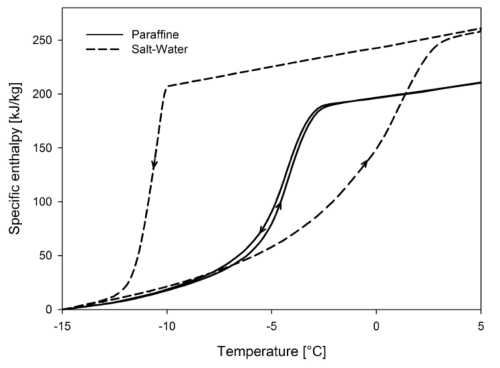
Fig. 2. Specific enthalpy as a function of temperature of the paraffin derivative (solid lines) compared to a salt-water mixture (dashed lines) (reproduced from Ref. [19] with permission from Elsevier, © 2015)
In general, PCMs are divided into 3 groups based on the source of PCM, namely organic, inorganic, and eutectic PCMs. Each group is further subdivided into subgroups as shown on Fig. 3, while Table 2 summarizes the general advantages and drawbacks of each group.
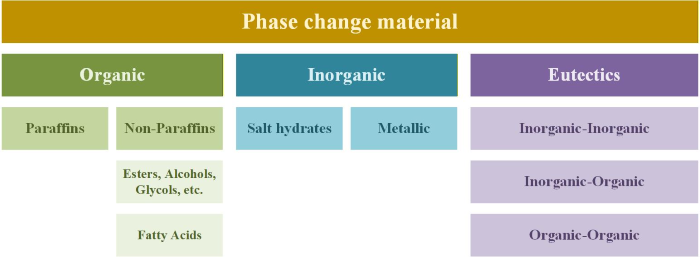
Fig. 3. Classification of PCMs (adapted from [18])
Organic PCMs are divided into paraffins and non-paraffins, which are further subdivided into fatty acids and hydrocarbonates. Examples of parrafins are paraffin wax, 𝑛-tridecane, and 𝑛-trioctane. In general, paraffins have the chemical formula C𝑛H2𝑛+2, where 𝑛 is further explained in [20,21]. They are quite expensive but are still most commercially used PCM due to their properties. Fatty acids are about two to three-times more expensive in comparison to paraffins [18]. They have the chemical formula CH3(CH2)𝑥 COOH, where 𝑥 is further explained in [6,23]. Examples of fatty acids are acetic acid and stearic acid, while other non-paraffins are: beeswax, esters, and glycerol (glycerin).
Table 2. General properties for specific type of PCM [7-10,18,22]
| Desired properties | Organic | Inorganic | Eutectic |
|---|---|---|---|
| high enthalpy change | low | high | high |
| high specific heat capacity | low | high | high |
| high thermal conductivity | low | high | low |
| low supercooling | almost none | high | low |
| low phase segregation | low | high | low |
| low volume change | high | smaller than organic | moderate |
| compatibility | non-corrosive | corrosive | n.a, |
| chemical stability | good | good | good |
| non-toxicity | non-toxic | partially | n.a. |
| non-flamability | highly flammable | low flammability | flammable (organic- based), non‑flammable (salt-based) |
| low price | low | low | high |
| recyclability | partially | yes | n.a. |
| abundance | yes | yes | no |
Inorganic PCMs are divided into salt hydrates with chemical formula AB · n H2O and metallic materials, i.e., metals with high latent heat capacity. Salt hydrates are the oldest and most studied PCMs and their cost is low due to their easy availability. Nevertheless, salt hydrates have many drawbacks, such as corrosion of metal material, supercooling, and phase separation, i.e., salts settle to the bottom (due to higher density) and reduce the active volume. Metals as PCMs are not seriously considered for commercialization due to high density and high cost.
Eutectic PCMs consist of two or more components combined at a specific composition that results in a single, well-defined melting and solidification temperature. Unlike non-eutectic mixtures, they undergo phase change at nearly constant temperature, similar to pure substances. Eutectic behavior can occur in both organic and inorganic systems, including salt hydrates, and is therefore not a separate material class but a compositional characteristic. Consequently, the classification presented in Fig. 3 distinguishes materials primarily by their chemical nature, while eutectic mixtures may exist within each category.
The advantage of a mixture is the ability to carefully adjust the temperature of phase change and to use the advantages of both components, resulting in better properties of the substance. However, eutectic substances are expensive.
In research, water is often used as PCM because it has outstanding heat transfer and heat storage properties (i.e., high latent heat, high specific heat, and high thermal conductivity), low environmental impact, and low price. However, the main disadvantages of water are phase separation (ice floats on liquid water), large volume change during solidification and the need for severe supercooling to freeze. In addition, the phase change temperature is not optimal for either the fresh food compartment or the freezer. More details about the optimal phase change temperatures of PCM for refrigeration systems are presented in Section 3.
Over the last years, the number of PCMs available on the market has increased. This includes new types of PCMs and a significant increase in the number of suppliers. Table 3 gathers commercially available PCMs with a melting temperature (Tm) between −21 °C and 7 °C. These PCMs are available in a variety of forms, including bulk, macro-encapsulated, and dry micro-encapsulated powder. For more details and other commercially available PCMs (with Tm < −12 °C or Tm > 8 °C) see [8].
Table 3. Commercially available PCMs in the temperature range from −21 °C to 7 °C, sorted by melting temperature
| Material | 𝑇m (◦C) | Latent heat
(kJ kg-1) |
Type | Producer |
|---|---|---|---|---|
| va-Q-accu – 21G | −21 | 234 | / | va-Q-tec |
| ClimSel C-21 | −21 | 285 | inorganic | Climator AB |
| PureTemp –21 | −21 | 239 | bio-based organic | PureTemp LLC |
| E-21 | −21 | 285 | inorganic | PCM Products |
| ATS-21 | −21 | 320 | inorganic | Axiotherm GmbH |
| SP-21 | −21 | 285 | inorganic | Rubitherm GmbH |
| E-19 | −19 | 300 | inorganic | PCM Products |
| HS18N | −18 | 242 | inorganic | PLUSS Advanced Technologies |
| BioPCM® | −18 | 200 | organic | Phase-change Energy Solutions Inc. |
| ClimSel C-18 | −18 | 288 | inorganic | Climator AB |
| SP-17 | −17 | 300 | inorganic | Rubitherm GmbH |
| E-15 | −15 | 320 | inorganic | PCM Products |
| HS15N | −15 | 308 | inorganic | PLUSS Advanced Technologies |
| PureTemp –15 | −15 | 301 | bio-based organic | PureTemp LLC |
| BioPCM® | −15 | 200 | organic | Phase-change Energy Solutions Inc. |
| ATS-12 | −12 | 360 | inorganic | Axiotherm GmbH |
| E-11 | −11 | 310 | inorganic | PCM Products |
| SP-11 | −11 | 240 | inorganic | Rubitherm GmbH |
| SP-11 UK | −11 | 330 | inorganic | Rubitherm GmbH |
| PCM-10 | −10 | 180 | inorganic | Microtek Laboratories |
| MPCM-10 | −10 | 175 | inorganic | Microtek Laboratories |
| MPCM-10D | −10 | 175 | inorganic | Microtek Laboratories |
| HS10N | −10 | 290 | inorganic | PLUSS Advanced Technologies |
| RT-9 HC | −9 | 250 | organic | Rubitherm GmbH |
| HS7N | −7 | 296 | inorganic | PLUSS Advanced Technologies |
| SP-7 | −7 | 290 | inorganic | Rubitherm GmbH |
| ATS-6 | −6 | 360 | inorganic | Axiotherm GmbH |
| E-6 | −6 | 300 | inorganic | PCM Products |
| RT-4 | −4 | 180 | organic | Rubitherm GmbH |
| E-3 | −3 | 330 | inorganic | PCM Products |
| HS3N | −3 | 346 | inorganic | PLUSS Advanced Technologies |
| ATS-3 | −3 | 330 | inorganic | Axiotherm GmbH |
| PureTemp –2 | −2 | 277 | inorganic | PureTemp LCC |
| E-2 | −2 | 325 | inorganic | PCM Products |
| RT0 | 0 | 175 | organic | Rubitherm GmbH |
| ClimSel CZ | 0 | 393 | inorganic | Climator AB |
| E0 | 0 | 395 | inorganic | PCM Products |
| va-Q-accu +00G | 0 | 330 | / | va-Q-tec |
| HS01 | 1 | 350 | inorganic | PLUSS Advanced Technologies |
| A2 | 2 | 230 | organic | PCM Products |
| ATP 2 | 2 | 215 | organic | Axiotherm GmbH |
| RT2 HC | 2 | 200 | organic | Rubitherm GmbH |
| OM03 | 3 | 229 | organic | PLUSS Advanced Technologies |
| FS03 | 3 | 161 | organic (fatty acid) | PLUSS Advanced Technologies |
| RT3 HC | 3 | 190 | organic | Rubitherm GmbH |
| A3 | 3 | 230 | organic | PCM Products |
| RT4 | 4 | 175 | organic | Rubitherm GmbH |
| PureTemp 4 | 4 | 187 | organic | PureTemp LLC |
| A4 | 4 | 235 | organic | PCM Products |
| BioPCM® | 4 | 210 | organic | Phase-change Energy Solutions Inc. |
| SP5 gel | 5 | 155 | inorganic | Rubitherm GmbH |
| va-Q-accu +05G | 5 | 240 | / | va-Q-tec |
| RT5 | 5 | 180 | organic | Rubitherm GmbH |
| RT5 HC | 5 | 250 | organic | Rubitherm GmbH |
| OM05P | 5 | 216 | organic | PLUSS Advanced Technologies |
| A5 | 5 | 170 | organic | PCM Products |
| CrodaTherm | 5 | 191 | bio-based organic | Croda |
| ATP 6 | 6 | 275 | organic | Axiotherm GmbH |
| A6 | 6 | 185 | organic | PCM Products |
| BioPCM® | 6 | 210 | organic | Phase-change Energy Solutions Inc. |
| A6.5 | 6.5 | 190 | organic | PCM Products |
| CrodaTherm 6.5 | 6.8 | 184 | Organic plant-based | Croda |
| Gaia OM PCM 7 | 7 | 180 | organic | Global-E-Systems |
| ClimSel C7 | 7 | 123 | inorganic | Climator AB |
| SP7 gel | 7 | 155 | inorganic | Rubitherm GmbH |
| A7 | 7 | 190 | organic | PCM Products |
From an economic perspective, the cost of PCM materials varies significantly depending on composition, purity, and encapsulation. Typical commercial PCM materials are generally in the range of approximately 3 to 20 EUR/kg, depending on material type and form. The overall system cost associated with PCM integration depends strongly on the design and application, including encapsulation methods and integration complexity.
3 VARIOUS PCM PLACEMENTS IN THE REFRIGERATION SYSTEM
PCM can be placed in different areas of the refrigerator as shown in Fig. 4, including coupling with the evaporator, coupling with the condenser, placement inside the refrigerated compartment, and integration within cabinet walls. The most studied placement is the placement of PCM at the evaporator [19,20,23-37] and in the compartment (cabinet) [38-43]. Further, there are studies on the placement of PCM at the condenser [35,44-48], and few that consider PCM at different locations in the vapor-compression system [49]. Some studies even consider different combinations of PCM placements, e.g., at the condenser & compartment [21], and at the evaporator & condenser [19,35,50].
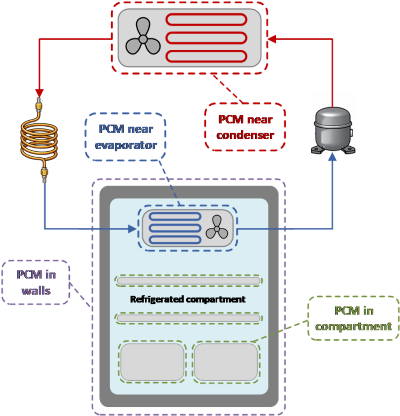
Fig. 4. Representative PCM integration locations in a vapor-compression household refrigerator
3.1 PCM at the Evaporator
During the compressor ON time, heat transfer from PCM at the evaporator causes cooling of PCM, leading to its solidification. When it solidifies, PCM is “charged” and has stored cold energy. During the compressor OFF time, the discharge process begins, resulting in heat transfer from the compartment to PCM. Meanwhile, PCM begins to liquefy and heat up. As a result, the temperature in the compartment remains lower for a longer period of time (Fig. 5). As already mentioned, PCM additionally causes a higher evaporation temperature at the evaporator due to better heat transfer conditions between PCM and the evaporator wall (compared to evaporator wall and air), resulting in a higher COP.
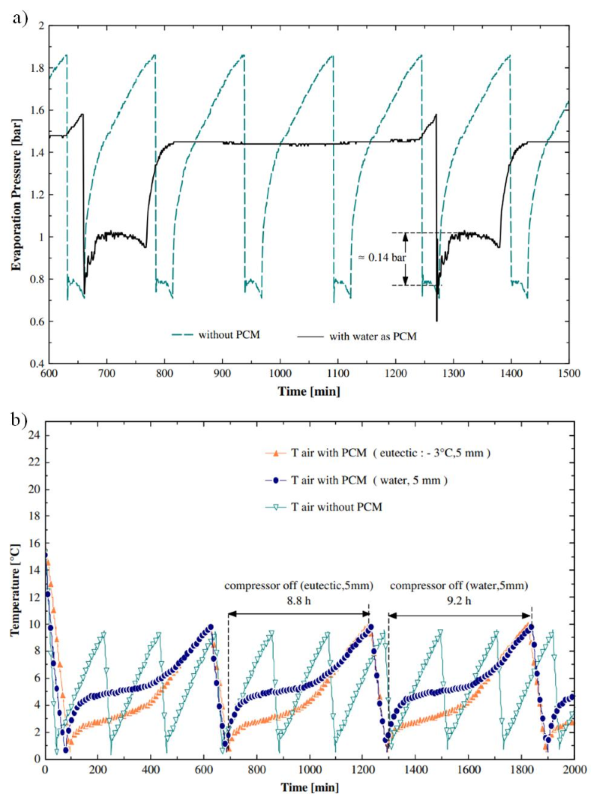
Fig. 5. a) Evolution of evaporation pressure (temperature) with and without PCM and b) evolution of average air temperature in compartment with and without PCM (reproduced from Ref. [25] with permission from Elsevier, © 2009)
Figure 5a shows the evolution of the evaporation pressure in the evaporator for a refrigerator with and without PCM. The evaporation pressure is directly related to the evaporation temperature, i.e. the higher the pressure, the higher the temperature. During the compressor ON time, the evaporating pressure is higher when using PCM than in the absence of PCM. The difference in this particular case is 0.14 bar, which corresponds to a difference of about 3 K in evaporating temperature. During the compressor OFF time, the evolution of the pressure in the evaporator exhibits flat plateau corresponding to the liquefaction of PCM. In addition, longer compressor ON and OFF times can be observed, which is also shown in Fig. 5b, where temperature fluctuations inside the compartments are shown for three cases: I) without PCM, II) water/ice as PCM, and III) eutectic aqueous solution as PCM. In both cases where PCM is used, a longer compressor OFF time is observed.
The main advantage of using PCM at the evaporator is the improvement of the coefficient of performance (COP) of the system due to the higher evaporator temperature (Fig. 5a) and the higher density of the refrigerant at the compressor inlet [25] (the mass flow from the evaporator by the fixed volumetric displacement of the compressor is higher). According to the review paper [11], COP increase of 2 % to 74 % can be expected, depending on the type of PCM used, thermal load, ambient temperature, and operating conditions. More specifically, the use of PCM in contact with the evaporator improves heat transfer from the evaporator [24]. As a result, a higher evaporator temperature (and pressure) is obtained during the compressor ON time. In turn, the compressor inlet temperature also increases. Thus, the performance improvement of a system equipped with PCM on the evaporator side is somewhat limited by the high condensation temperature. Nevertheless, the use of PCM at the evaporator leads to an increase in performance, since the compressor efficiency is generally more sensitive to the evaporation temperature.
In addition to a higher evaporator temperature, PCM can also store excess cooling capacity of the system, i.e., it helps the refrigeration system with cold storage. As a result, a longer compressor OFF time (e.g., 310 % and 456 % longer in [19] and [31], respectively) and a lower ON-to-OFF time ratio (e.g., 25 % and 12.6 % lower in [19] and [31], respectively) are achieved (Fig. 5b), resulting in lower overall energy consumption (e.g., 10 %, 13.7 % and 17 % lower in [32], [51] and [19], respectively) and preventing the destructive effect of frequent compressor start/stop. A longer compressor OFF time is also beneficial in terms of future demand side management (DSM) concepts. DSM generally refers to the specific control of power use to meet a fluctuating power supply. Specifically for refrigeration, DSM aims to reduce energy consumption during peak hours and shift energy purchases to low-cost periods. The potential to shift refrigerator demand to off-peak hours results in a reduction in customer bills of approximately 11 % [52]. Furthermore, PCM as a cold energy storage helps maintain food quality due to lower and less frequent temperature fluctuations inside the compartment [39]. The measured results by Rahimi et al. [51] indicated that by placing a PCM slab under the evaporator surface, the cabin temperature remains in the standard range (PCM slab with copper showed 1.7 °C and 5.1 °C temperature difference between the lowest and the highest cabin temperatures).
In addition, PCM can be helpful in case of power outages, because it increases the thermal capacity of the compartment and compensates for the heat gain through the compartment walls. Another advantage related to the lower ON-to-OFF ratio is less generated noise due to the lower overall ON time of the compressor. Table 4 gathers main benefits and drawbacks of using PCM at the evaporator.
The phase change temperature of PCM should be within the temperature range of the refrigerator thermostat [11], i.e. between the lower temperature at which compressor is stopped and the higher temperature at which compressor is started. Therefore, refrigerator’s thermostat temperature range represents the upper and lower limits of applicable phase change temperatures of PCMs. In a case of high phase change temperature of PCM (closer to the upper limit) system performance is better because the compressor ON-to-OFF ratio is reduced and COP is higher owing to the higher evaporation temperature, while stored food quality is decreased due to higher temperature in compartment. On the contrary, in case of lower phase change temperature of PCM (closer to the lower limit), PCM does not perform well because phase change might occur partially. It is therefore critical to select PCM with the correct phase change temperature based on expected thermal load.
Table 4. Benefits and drawbacks of PCM at the evaporator
| Benefit | Drawback |
|---|---|
| Higher COP | Higher condensation temperature |
| Longer compressor OFF time | Longer compressor ON time |
| Lower compressor ON-to-OFF time ratio à lower energy consumption | |
| Slower temperature changes in compartment | |
| More stable conditions against thermal load variations (i.e. outside temperature and door openings) | |
| Higher refrigerant density and more controlled temperature at compressor inlet | |
| Positive effect in case of power outage | |
| Less overall noise |
With high degree of supercooling, the rate of nucleation in PCM substance is very slow resulting in a long freezing time. In a refrigeration system, a high supercooling degree will cause lower evaporating temperature and reduce the refrigeration efficiency. The thickness of PCM is also important. In general, thicker PCM performs better due to larger heat storage capacity. However, there is a limit of PCM that can be solidified during compressor ON time and above that limit thickness increase has no beneficial effects [25]. For example, in Fig. 6 temperature distribution of 10 mm thick PCM at the end of compressor ON time is shown. Measurements indicate that only about 60 % of PCM is solidified, which corresponds to complete solidification of 6 mm thick PCM. Therefore, increasing the thickness above 6 mm does not provide additional benefits under the studied conditions, as heat transfer limitations dominate. However, this limitation may be mitigated if the thermal conductivity of the PCM is enhanced, for example through the use of fins, metal matrices or high-conductivity additives.
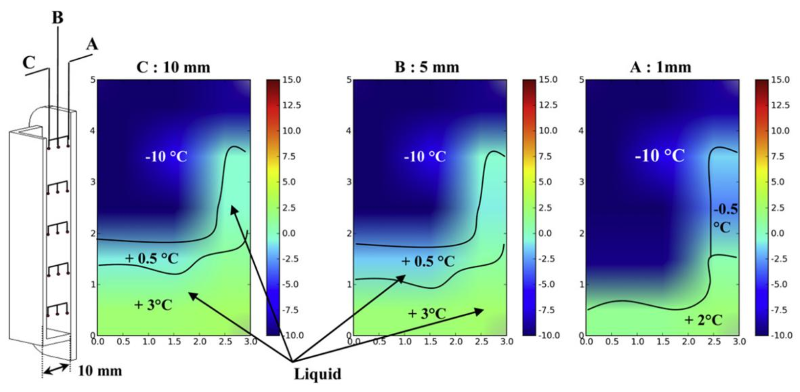
Fig. 6. Partial freezing: temperature distribution in PCM at different distances from the evaporator (reproduced from Ref. [25] with permission from Elsevier, © 2009)
3.2 PCM at the Condenser
During the compressor ON time, the heat transfer from the condenser to PCM leads to heating of PCM, resulting in its melting. Due to the better heat transfer conditions, the heat transfer is faster compared to an ordinary refrigerator without PCM, while the condensation temperature is lower due to the right selection of the phase change temperature of the PCM. Consequently, to lower condensing temperature improves COP and reduces energy consumption. When PCM is liquefied, it is “charged” and has stored energy (heat). During the compressor OFF time, the heat stored in PCM is released to the environment, which cause the solidification of PCM. This process extends the condenser heat rejection from the compressor ON time to the entire cycle including the compressor OFF time (see Fig.7, where the blue curve is always above ambient temperature).
The idea of using PCM at the condenser is to achieve lower temperatures in the condenser during the compressor ON time [11], which generally results in a higher COP. According to literature [44], PCM at the condenser also causes a higher temperature at the evaporator, which is also beneficial for the increase of the COP. Unfortunately, no evaluation of COP improvement (in %) has been done so far. Lower condensation temperatures (e.g., 22 % lower [45]) are a result of improved heat transfer from the refrigerant (to the environment) due to the contact between the condenser and PCM, which allows heat conduction (i.e., thermal conductivity improvement), and the larger convection surface between the condenser (including PCM) and the environment. As a consequence, to enhanced heat transfer of the condenser, a shorter compressor ON time (e.g., 15 % shorter [47]) is required to reject a similar amount of heat from the compartment. Thus, the ON-to-OFF time ratio is lower (e.g., 22 % lower [47]) due to the shorter ON time and the nearly unchanged OFF time. A lower ON-to-OFF time ratio [47] is directly related to lower energy consumption and according to the literature, refrigerator energy consumption can be reduced between 7.4 % and 18 % [46,48], if PCM is used at the condenser.
Moreover, PCM at the condenser increases system stability by increasing subcooling (and decreasing condensation pressure), resulting in lower temperature fluctuations in the food compartments (Fig. 7a). In this context, increased subcooling refers to a larger temperature difference between the condensing temperature and the liquid refrigerant temperature at the condenser outlet. Unlike an ordinary system where condenser heat rejection is limited to compressor ON time, while during OFF time temperature of condenser equals the ambient temperature, the use of PCM at the condenser allows heat rejection also during compressor OFF time, resulting in a potential increase of overall rejected heat in a compressor cycle (Fig. 7b). A higher condenser temperature (and consequently a higher refrigerant temperature in the condenser) during compressor OFF time brings another benefit, namely the need for lower compressor starting power.
Unfortunately, PCM at condenser brings several disadvantages. Although the ON-to-OFF time ratio of the compressor is lower, resulting in lower energy consumption, it is lower on the account of lower compressor ON time, which results in more frequent start/stop of the compressor. This shortcoming negatively affects the compressor performance in long-term use. All the benefits of PCM at the condenser are compromised by this major shortcoming, which may be the reason why PCM at the condenser is not investigated as frequently as PCM at the evaporator. Furthermore, the relatively unchanged compressor OFF time [47] shows that the accumulated cold storage in the compartment remains unchanged. Therefore, PCM at the condenser is not helpful in case of power outages and does not allow shifting energy purchases into off-peak hours.
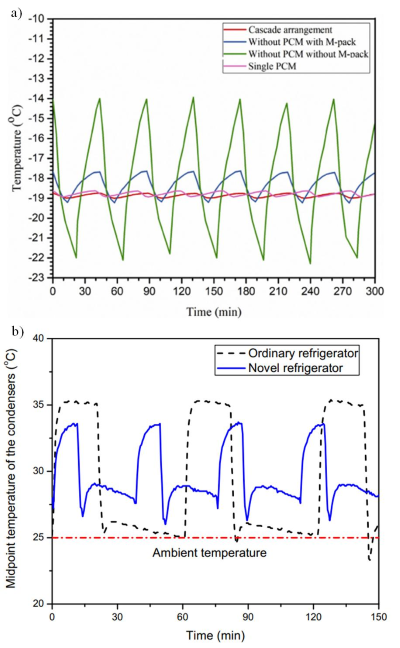
Fig. 7. a) Comparison of the temperature fluctuation in the frozen-food compartment between the four different refrigerators (reproduced from Ref. [47] with permission from Elsevier, © 2019), and (b) comparison of the condenser midpoint temperatures, where “novel refrigerator” uses PCM at the condenser (reproduced from Ref. [44] with permission from Elsevier, © 2011)
Figure 7a shows the profiles of average temperatures in the compartment for four different cases. It should be noticed that the average temperature for the case without PCM or M-packs is associated with the average air temperature inside the compartment, which illustrates the largest temperature fluctuations in comparison to the other cases. In other three cases the profiles show the average temperatures of the M-packs loaded inside the compartment. To clarify, M-pack is a package that simulates thermal mass of food in the compartment, which means it contributes to the thermal inertia of a compartment. In [38] M-packs with chemical compositon of 76.42 wt% water, 23.0 wt% oxyethylmethylcellulose, 0.5 wt% sodium chloride, and 0.08 wt% parachloromethacresol were used. Figure 7a shows that the temperature fluctuations are lower when PCM is used. More specifically, the temperature fluctuations decreased from 1.4 °C to 0.25 °C when one PCM is used, while the use of PCM in cascade arrangement reduces the fluctuations to 0.15 °C.
Figure 7b shows the comparison of condenser midpoint temperatures for the ordinary refrigerator (without PCM) and the novel refrigerator (with PCM). For the ordinary refrigerator, the condenser midpoint temperature rose rapidly from the ambient temperature (about 25 °C) to the highest temperature (about 35 °C) after the compressor was started and remained at this temperature. When the compressor was stopped, the temperature dropped rapidly and approached the ambient temperature. It then increased slightly (due to the influence of the heat capacity of the cabinet) and then slowly decreased until the next cycle began. The average temperature over a complete cycle was 28.6 °C, while the average temperatures during the ON time and the OFF time were 34.8 °C and 25.8 °C, respectively.
Unlike the ordinary refrigerator, the condenser midpoint temperature of the novel refrigerator increased more slowly after the compressor was turned on, reaching the highest temperature, which was about 2 °C lower than that of the ordinary refrigerator. When the compressor stopped, the sudden pressure drop inside the condenser resulted in a sudden drop of the condenser midpoint temperature. After that, the temperature increased rapidly to about 29 °C due to the effect of the PCM whose phase change temperature is higher than the ambient temperature. Then the temperature declined slowly as PCM released heat to the environment, but the minimum temperature was still over 27.5 °C, which was about 2.5 °C higher than the ambient temperature. For the novel refrigerator, the average temperature over a complete cycle was 29.9 °C, and the average temperatures during the ON time and the OFF time were 32.5 °C and 28.8 °C, respectively. For the novel refrigerator, the condenser midpoint temperature was higher than the ambient temperature by 3 °C to 5 °C, which indicates that nearly 50 % of the condensation heat is released into the environment through the PCM during the OFF time. Table 5 gathers the main benefits and drawbacks of using PCM at the condenser.
Kurugonda and Prasad [53] modified a household vapor compression refrigeration system using R134a by adding a PCM at the condenser to store excess heat and a Peltier module at the evaporator to improve cooling efficiency. Experimental results showed that using both components together reduced power consumption by 21 % and increased the coefficient of performance (COP) by 17.6 % compared to a normal cycle. The findings demonstrated that integrating PCMs and Peltier modules enhances the system’s energy efficiency and reduces compressor workload.
Table 5. Benefits and drawbacks of PCM at condenser
| Benefit | Drawback |
|---|---|
| higher COP | frequent start/stop of compressor |
| shorter compressor ON time | more refrigerant displacement losses due to frequent start/stop |
| lower ON-to-OFF time ratio -> lower energy consumption | |
| lower condensation temperature and pressure | |
| higher degree of subcooling (greater ΔT below condensing temperature) | |
| continuous heat rejection from condenser even during compressor OFF time | |
| lower starting compressor power due to higher refrigerant temperature in condenser (during OFF time) |
3.3 PCM in the Compartment
PCM can be integrated into walls, trays or into the top and bottom part of the compartment. The idea of using PCM in the compartment is to increase stored cold in the refrigerator. The results show that the introduction of PCM increases the cooling capacity, i.e. required time to cool a specific load from 25 °C to 10 °C, by up to 33 % [42]. Additionally, PCM increases the temperature rise time, i.e. required time for temperature in the compartment to rise from 8 °C to 11 °C, by up to 145 % [42]. This means that compressor OFF time is longer (e.g., 250 % longer [43]), while ON-to-OFF time ratio is lower (e.g., 38 % lower [43]), which results in lower energy consumption. According to the literature, energy savings from 8.4 % [41] to 12.1 % [43] can be expected. Additionally, longer compressor OFF time allows electricity usage to be shifted to off-peak times, which is beneficial in terms of demands-side management (DMS). Moreover, PCM in the compartment is also beneficial in case of power outages, because temperature in the compartment remains lower for a longer period of time (Fig. 6a). Besides increased stored cold, PCM in the compartment also significantly reduces temperature fluctuations during normal operation (up to 38 % [43]), which results in the enhancement of nutrition properties of stored food [39,43]. In case of door opening, PCM in the compartment reduces temperature fluctuations and lowers the requirement for starting the compressor because incoming warm air can be cooled down by PCM [39] (Fig. 8b).
Figure 8a shows the average air temperature inside the cabinet with and without PCM during the power failure condition. The results show that the air temperature inside the cabinet increased rapidly in the absence of PCM, resulting in large temperature fluctuations.
With PCM, the system was maintained at about 3 °C lower temperature during the power failure time. With power failure, the temperature inside the cabinet begins to rise due to the heat coming from the environment through the insulation. If PCM can be placed in the cabinet, it absorbs some of the heat by changing its phase from solid to liquid. Figure 8b shows the effects of PCM on the average air temperature inside the cabinet. The average temperature fluctuation was between 3 °C and 5.5 °C without PCM, while the temperature fluctuation decreased with PCM. Consequently, the refrigerator with PCM maintained a more stable temperature in the closed-door condition. Additionally, a longer compressor ON and OFF time was observed when PCM was used. On the other hand, in the door opening conditions, the temperature increased rapidly and caused a significant temperature fluctuation in the absence of PCM. With PCM, a smaller temperature fluctuation was observed by about 3 °C, compared to the fluctuation without PCM. This is because the PCM works as a temperature damper.
The overall effect of using PCM in the compartment is similar to using PCM at the evaporator, except that it has no effect on the evaporating temperature in the evaporator. Also, PCM may have a larger volume in the compartment, resulting into longer charging times due to more stored cold. The working principle is similar to PCM at the evaporator (Section 3.1). Table 6 gathers benefits and drawbacks of using PCM in the compartment. An important practical consideration is the potential reduction of usable storage volume when PCM is placed directly within the refrigerated compartment. Depending on the integration strategy, PCM may occupy space that would otherwise be available for stored goods. However, this drawback can be mitigated by integrating PCM into structural elements such as walls or shelves, where it may partially replace insulation or serve a dual function. In such configurations, the impact on usable volume may be negligible while still providing thermal stability and improved performance during transient conditions such as door openings or power outages.
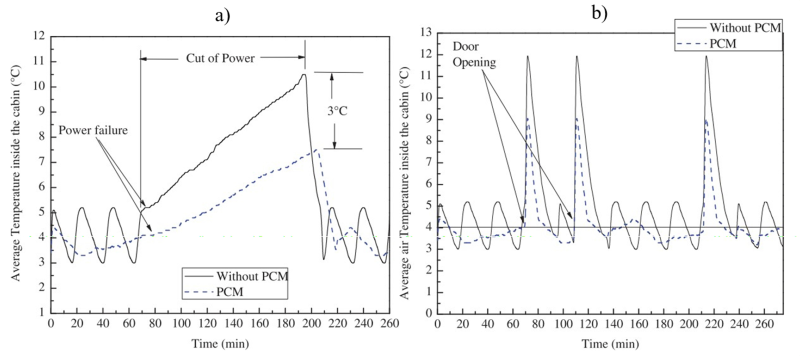
Fig. 8. Average air temperature inside the compartment: a) at power cut off condition and b) at door opening condition (reproduced from Ref. [39] with permission from Taylor & Francis, © 2017)
Table 6. Benefits and drawbacks of PCM in the compartment
| Benefit | Drawback |
|---|---|
| reduced temperature fluctuations during normal operation | longer compressor ON time |
| lower sensitivity of temperature fluctuations to door openings | reduced usable storage volume, unless PCM is integrated into walls or structural elements |
| increased cooling capacity and temperature rise time | |
| slower temperature increase in case of power outage | |
| longer compressor OFF time | |
| lower ON-to-OFF time ratio -> lower energy consumption |
3.4 PCM in the Evaporator and the Condenser
The combination of PCM placements can lead to a synergistic effect, i.e., the advantages of one PCM placement outweigh the disadvantages of the other PCM placement. Consequently, the advantages of both PCM placements are expressed and utilized.
As presented in the previous sections, PCM at the evaporator increases the evaporation and condensing temperatures, while the compressor cycle is extended due to the longer compressor OFF time (ON-to-OFF ratio is lower). On the other hand, PCM at the condenser lowers the condensing temperatures while the compressor cycle is shortened, resulting in frequent starts and stops of the compressor. The simultaneous use of PCM at these locations leads to beneficial results, as shown in [19]. The duration of the compressor cycle remains almost unchanged (PCM at the evaporator and at the condenser cancel each other out), while the compressor OFF time is longer and consequently the ON-to-OFF time ratio is lower. Thus, energy consumption is reduced. According to the literature, a reduction of 17 % can be expected [19]. Moreover, evaporator temperatures are higher during compressor ON time and lower during compressor OFF time, while condenser temperatures are lower during compressor ON time and higher during compressor OFF time. According to experimental evaluation in [54], this led to a 12.7% increase in COP. In addition, the higher condenser temperatures during the OFF time indicate that the condenser is also releasing heat during the OFF time, which is an advantage of using PCM on the condenser. On the other hand, the benefit of using PCM at the evaporator is also utilized, namely, temperature fluctuations in the compartment are reduced by 50 % [50].
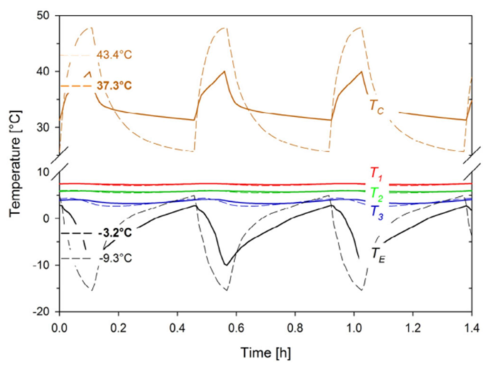
Fig. 9. Temperature of the fresh-food compartment (T1, T2, T3), of the evaporator (TE) and of the condenser (TC) without (dashed lines) and with PCM on evaporator and condenser (solid lines); numerical values indicate average evaporator and condenser temperatures during compressor runtime (reproduced from Ref. [19] with permission from Elsevier, © 2015)
Figure 9 shows the results for a combined integration of PCM into the evaporator and condenser of a commercial refrigerator. Thermostat settings were adjusted to reach the required average temperature in the compartment of about 5 °C. The cycle duration in both cases (with and without PCM) is similar; however, the relative compressor ON time (ON-to-total time ratio) decreases from about 24 % to 20 % with the PCM. The minimum evaporator temperature is increased with the integration of PCM by 6 °C from about −16 °C to −10 °C and on average during the compressor ON time by 6 °C from about −9.3 °C to −3.2 °C. The maximum condenser temperature is reduced by 8 °C from about 48 °C to 40 °C and on average during the compressor ON time by 6 °C from 43.4 °C to 37.3 °C. Altogether, this leads to a reduction of power consumption by about 17 %.
Although there are not many studies that consider PCM placement at multiple locations at the same time, numerical study [50] considers PCM placement at the evaporator and condenser. The authors estimate that PCM at the evaporator and condenser simultaneously is better in view of energy consumption and COP compared to separate PCM placement. More specifically, their results show 32 % lower energy consumption, an increase of COP up to 38 %, and 46 % reduction of compressor ON-to-OFF time ratio. Table 7 gathers the benefits and drawbacks of using PCM at the evaporator and condenser at the same time.
Table 7. Benefits and drawbacks of PCM at the evaporator and condenser at the same time
| Benefit | Drawback |
|---|---|
| higher evaporation temperatures during ON time -> higher COP | phase change temperatures of both PCMs must be adequately selected to achieve synergy |
| lower condensing temperatures during ON time -> higher COP | poor options to shift energy purchases to off-peak hours |
| lower ON-to-OFF time ratio -> lower energy consumption | |
| lower temperature fluctuations in the compartment | |
| ability of condenser to reject heat during OFF time |
3.5 PCM in Walls for Thermal Buffering
PCMs can enhance the thermal insulation of refrigeration systems by acting as thermal buffers that absorb and store heat as latent energy, thereby reducing and shifting peak heat transfer rates. Experimental studies, such as those by Fioretti et al. [55], demonstrated that adding a PCM layer (35 °C) to a walk-in freezer reduced peak wall temperatures by up to 14 °C and delayed heat flux peaks by about 4 hours, effectively lowering thermal loads. Similarly, Copertaro et al. [56] found that integrating PCMs into refrigerated container walls decreased peak heat loads by 20 % to 25 % and daily energy consumption by around 4 % to 5 %, confirming PCMs’ potential to improve energy efficiency in refrigeration applications.
An important consideration when integrating PCM into walls is the trade-off with conventional insulation. Increasing insulation thickness is generally an effective and cost-efficient way to reduce steady-state heat transfer. In contrast, PCM primarily influences transient thermal behavior by absorbing and releasing heat, thereby reducing peak heat loads and delaying heat flux. For example, researchers in [57] showed, in the context of building envelopes, that insulation is more effective for reducing overall energy consumption, while PCM provides benefits in peak load reduction and thermal buffering, with the combination of both yielding the best performance. Although these findings provide useful insight, it should be noted that such analyses have mainly been conducted for building applications, and similar systematic comparisons for household refrigeration systems remain limited. Therefore, PCM should be considered as a complementary solution to insulation, particularly in applications where transient thermal effects are important.
4 DISCUSSION
It is important to position the contribution of this review within the existing body of literature. While several previous reviews [7-13] have summarized PCM applications in refrigeration systems, they primarily focus on material properties, general integration approaches, and individual case studies. In contrast, the present work emphasizes a structured comparison of PCM integration at different locations within the refrigeration system, considering system-level performance indicators such as compressor cycling, temperature stability, and operational trade-offs. By synthesizing both earlier foundational studies and more recent contributions within a unified framework, this review aims to provide clearer guidance for practical implementation and system design.
In the first part of this work PCMs in general, their classification and properties are presented. Each group of PCM has some advantages and disadvantages, while the inorganic PCMs stand out for their performance for use in the refrigeration system. This is also reflected in their availability on the market, as can be seen in the table of commercially available PCM with phase change temperatures between −21 °C and 7 °C. The takeaway of the first part of this work is that there are already several commercially available PCMs in different forms that can be usefully utilized in the refrigerator.
The second part of this work focuses on the effects of PCM on the refrigeration system. Different PCM placements are considered and their benefits and drawbacks are also presented. Based on the review, the placement of PCM in the compartment is the easiest to design in terms of shape/size and selecting the correct phase change temperature, and in return offers many advantages with little to no significant disadvantages. The main advantages of using PCM in the compartment are reduced temperature fluctuations in the compartment, lower sensitivity to door opening, and the ability to shift energy purchases to off-peak hours. For PCM in the compartment, the influence of ambient (surrounding) temperature is low, especially if compared to the influence that ambient temperature has on PCM at the condenser. In view of the amount of work needed and the gains achieved, it is reasonable to start by incorporating PCM into the refrigerated compartment.
PCM at the evaporator provides similar benefits as PCM in the compartment with an additional advantage, i.e., improved heat transfer from the evaporator. This leads to higher evaporation temperatures and thus an increase in COP. From this point of view, PCM at the evaporator seems to be a better choice than PCM in the compartment but requires more design efforts. For example, the size of PCM is limited to the size of the evaporator, while the thickness of PCM needs to be carefully selected, as an excessively thick PCM layer may have negative consequences leading to a decrease in COP.
Designing PCM at the condenser requires caution, since the influence of ambient temperature is significant. If too low or too high phase change temperature is selected, no transformation occurs and the efficiency of the system will be reduced because PCM can act as an insulator. Using PCM only at the condenser is a poor option due to frequent starts and stops of the compressor. However, this can be avoided by: (i) using a lower-power compressor, or (ii) increasing the accumulated cold inside compartment, e.g. by using PCM at the evaporator. The latter option seems to be the most interesting, since the advantages of PCM at the evaporator outweigh the disadvantages of PCM at the condenser, and also bring other advantages, such as the possibility of shifting the energy purchases to off-peak hours. Therefore, we believe that the combination of PCM at the condenser and at the evaporator (perhaps also in the compartment) can bring the most advantages and the best performance, but on the other hand, it requires the most effort in design and manufacturing.
A key outcome of this structured analysis is that the effectiveness of PCM integration depends strongly on its placement within the system and on the interaction between thermal, hydraulic, and control aspects. This highlights the need to move beyond isolated component-level analysis toward integrated system design, where trade-offs between efficiency, stability, cost, and usability are explicitly considered. Table 8 summarizes our findings.
Table 8. Summary of options with comments
| Option | Location of PCM | Comment |
|---|---|---|
| 1. | in the compartment | for relatively low effort, a few benefits with little to no risky disadvantages are obtained |
| 2. | at the evaporator | more effort needed, but in return major advantage is gained: higher evaporating temperature that leads to higher COP |
| 3. | at the evaporator and in the compartment | thermal inertia of refrigerator is significantly increased, enabling to shift energy purchases to off-peak hours and the advantages of the options 1. and 2. remain |
| 4. | at the evaporator and condenser | significant effort is needed, however the most and the best advantages can be obtained |
| 5. | at the condenser | in order for benefits to outweigh the drawbacks, a compressor of lower power is required |
From a practical implementation perspective, the integration of PCM into refrigeration systems introduces additional design considerations related to system size, complexity, and cost. The incorporation of PCM requires additional volume for storage, encapsulation, and thermal interfaces, which may slightly increase the overall size of the appliance or reduce usable internal volume, depending on the integration strategy. Furthermore, system complexity increases due to the need for effective thermal coupling between PCM and system components, as well as careful selection of phase change temperature and material properties, which may introduce additional design constraints in manufacturing and system control.
From an economic perspective, PCM integration generally leads to higher initial system costs due to material, encapsulation, and integration requirements. The overall cost impact depends strongly on the chosen design, level of integration, and application-specific constraints. However, these additional costs may be partially offset by improved energy efficiency, reduced compressor cycling, and enhanced temperature stability. Despite these potential benefits, comprehensive techno-economic analyses for household refrigeration applications remain limited in the literature, and the overall feasibility depends strongly on operating conditions and system design.
5 CONCLUSIONS
This paper reviews the impact of PCM use in household refrigerators for cold storage. The main message of this article is that cold thermal energy storage using PCMs represents a promising and increasingly important technology for improving energy efficiency and sustainability in refrigeration systems. With climate change being society’s biggest challenge, there is an urgent need for energy efficiency improvements, particularly in refrigeration which significantly impacts peak power demand. Cold thermal storage using PCMs offers substantial benefits including:
- peak shaving of refrigeration demand,
- energy cost reduction by exploiting low-cost electricity hours,
- backup refrigeration during power outages.
The technology shows promise across the entire cold chain – from food transport and packaging to supermarket refrigeration and industrial systems. Scientific interest in this topic has significantly increased over the past five years, with extensive research demonstrating energy savings ranging from 4 % to 15 % across various applications. Although the reported energy savings indicate promising potential, the economic feasibility and payback period of PCM integration depend strongly on system design, PCM cost, and operating conditions. Due to the limited availability of consistent cost data in the literature, a detailed payback analysis is challenging. However, the reported efficiency improvements suggest that PCM integration may lead to reasonable payback periods, particularly in applications with high electricity costs or frequent thermal load fluctuations. Despite proven benefits and commercial availability, widespread implementation in refrigeration is still lacking, primarily due to high initial costs and challenging system design.
References
- International Energy Agency, Renewables 2022: Analysis and Forecast to 2027 (2022) https://www.iea.org/reports/renewables-2022, accessed on 2026-06-18.
- Morciano, M., Fasano, M., Chiavazzo, E., Mongibello, L. Trending applications of Phase Change Materials in sustainable thermal engineering: An up-to-date review. Energy Convers Manage: X 25 100862 (2025) DOI:10.1016/j.ecmx.2024.100862.
- Martínez, F.R., Borri, E., Mani Kala, S., Ushak, S., Cabeza, L.F. Phase change materials for thermal energy storage in industrial applications, Heliyon 11 e41025 (2025) DOI:10.1016/j.heliyon.2024.e41025.
- Mika, Ł., Radomska, E., Sztekler, K., Gołdasz, A., Zima, W. Review of selected PCMs and their applications in the industry and energy sector. Energies 18 1233 (2025) DOI:10.3390/en18051233.
- Dupont, J.L. The Role of Refrigeration in the Global Economy. 38th Note on Refrigeration Technologies, IIF-IIR, Paris (2019) DOI:10.18462/iif.NItec38.06.2019.
- Dalkilic, A., Wongwises, S. A performance comparison of vapour-compression refrigeration system using various alternative refrigerants. Int Commun Heat Mass 37 1340-1349 (2010) DOI:10.1016/j.icheatmasstransfer.2010.07.006.
- Omara, A.A.M., Mohammedali, A.A.M. Thermal management and performance enhancement of domestic refrigerators and freezers via phase change materials: A review. Innov Food Sci Emerg 66 102522 (2020) DOI:10.1016/j.ifset.2020.102522.
- Selvnes, H., Allouche, Y., Manescu, R.I., Hafner, A. Review on cold thermal energy storage applied to refrigeration systems using phase change materials. Therm Sci Eng Prog 22 100807 (2021) DOI:10.1016/j.tsep.2020.100807.
- Pahamli, Y., Valipour, M.S. Application of phase change materials in refrigerator and freezer appliances: A comprehensive review. J Heat Mass Transf Res 8 87-104 (2021) DOI:10.22075/JHMTR.2021.24419.1406.
- Ghosh, D., Ghose, J., Datta, P., Kumari, P., Paul, S. Strategies for phase change material application in latent heat thermal energy storage enhancement: Status and prospect. J Energy Storage 53 105179 (2022) DOI:10.1016/j.est.2022.105179.
- Mastani Joybari, M., Haghighat, F., Moffat, J., Sra, P. Heat and cold storage using phase change materials in domestic refrigeration systems: The state-of-the-art review. Energy Build 106 111- 124 (2015) DOI:10.1016/j.enbuild.2015.06.016.
- Abdolmaleki, L., Berardi, U. Single and multi-phase change materials used in cooling systems. Int J Thermophys 43 61 (2022) DOI:10.1007/s10765-022-02989-z.
- Deshmukh, M.S., Deshmukh, D.S., Chavhan, S.P. A critical assessment of the implementation of phase change materials in the VCC of refrigerator. J Therm Eng 8 562-572 (2022) DOI:10.18186/thermal.1149392.
- Ouaouja, Z., Ousegui, A., Toublanc, C., Rouaud, O., Havet, M. Phase change materials for cold thermal energy storage applications: A critical review of conventional materials and the potential of bio-based alternatives. J Energy Storage 110 115339 (2025) DOI:10.1016/j.est.2025.115339.
- Simonsen, G., Ravotti, R., O’Neill, P., Stamatiou, A. Biobased phase change materials in energy storage and thermal management technologies. Renew Sust Energy Rev 184 113546 (2023) DOI:10.1016/j.rser.2023.113546.
- Benhorma, A., Bensenouci, A., Teggar, M., Ismail, K.A.R., Arıcı, M., E. Mezaache, A. et al. Prospects and challenges of bio-based phase change materials: An up to date review. J Energy Storage 90A 111713 (2024) DOI:10.1016/j.est.2024.111713.
- Cheralathan, M., Velraj, R., Renganarayanan, S. Performance analysis on industrial refrigeration system integrated with encapsulated PCM-based cool thermal energy storage system. Int J Energ Res 31 1398-1413 (2007) DOI:10.1002/er.1313.
- Rathod, M.K., Banerjee, J. Thermal stability of phase change materials used in latent heat energy storage systems: A review. Renew Sust Energy Rev 18 246-258 (2013) DOI:10.1016/j.rser.2012.10.022.
- Sonnenrein, G., Baumhogger, E., Elsner, A., Fieback, K., A. Morbach, Paul, A. et al. Copolymer- bound phase change materials for household refrigerating appliances: experimental investigation of power consumption, temperature distribution and demand side management potential. Int J Refrig 60 166-173 (2015) DOI:10.1016/j.ijrefrig.2015.06.030.
- Marques, A.C., Davies, G.F., Maidment, G.G., Evans, J.A., Wood, I.D. Novel design and performance enhancement of domestic refrigerators with thermal storage. Appl Therm Eng 63 511-519 (2014) DOI:10.1016/j.applthermaleng.2013.11.043.
- Karthikeyan, A., Aakhash Sivan, V., Maher Khaliq, A., Anderson, A. Performance improvement of vapour compression refrigeration system using different phase changing materials. Mater Today Proc 44 3540-3543 (2021) DOI:10.1016/j.matpr.2020.09.296.
- Sidik, N.A.C., Kean, T.H., Chow, H.K., Rajaandra, A., Rahman, S., Kaur, J. Performance enhancement of cold thermal energy storage system using nanofluid phase change materials: A review. Int Commun Heat Mass 94 85-95 (2018) DOI:10.1016/j.icheatmasstransfer.2018.03.024.
- Ghahramani Zarajabad, O., Ahmadi, R. Employment of finned PCM container in a household refrigerator as a cold thermal energy storage system. Therm Sci Eng Prog 7 115-124 (2018) DOI:10.1016/j.tsep.2018.06.002.
- Azzouz, K., Leducq, D., Gobin, D. Performance enhancement of a household refrigerator by addition of latent heat storage. Int J Refrig 31 892-901 (2008) DOI:10.1016/j.ijrefrig.2008.03.018.
- Azzouz, K., Leducq, D., Gobin, D. Enhancing the performance of household refrigerators with latent heat storage: An experimental investigation. Int J Refrig 32 1634-1644 (2009) DOI:10.1016/j.ijrefrig.2009.03.012.
- Yusufoglu, Y., Apaydin, T., Yilmaz, S., Paksoy, H. O. Improving performance of household refrigerators by incorporating phase change materials. Int J Refrig 57 173-185 (2015) DOI:10.1016/j.ijrefrig.2015.04.020.
- Liu, Z., Zhao, D., Wang, Q., Chi, Y., Zhang, L. Performance study on air-cooled household refrigerator with cold storage phase change materials. Int J Refrig 79 130-142 (2017) DOI:10.1016/j.ijrefrig.2017.04.009.
- Elarem, R., Mellouli, S., Abhilash, E., Jemni, A. Performance analysis of a household refrigerator integrating a PCM heat exchanger. Appl Therm Eng 125 1320-1333 (2017) DOI:10.1016/j.applthermaleng.2017.07.113.
- Cofre-Toledo, J., Vasco, D.A., Isaza-Roldan, C.A., Tangarife, J.A. Evaluation of an integrated household refrigerator evaporator with two eutectic phase-change materials. Int J Refrig 93 29-37 (2018) DOI:10.1016/j.ijrefrig.2018.06.003.
- Geete, P., Singh, H.P., Somani, S.K. Performance analysis by implementation of microencapsulated PCM in domestic refrigerator: A novel approach. Int J Appl Eng Res 13 14365-14371 (2018).
- Maiorino, A., Del Duca, M.G., Mota-Babiloni, A., Greco, A., Aprea, C. The thermal performances of a refrigerator incorporating a phase change material. Int J Refrig 100 255-264 (2019) DOI:10.1016/j.ijrefrig.2019.02.005.
- Berdja, M., Hamid, A., Sari, O. Characteristics and thickness effect of phase change material and frost on heat transfer and thermal performance of conventional refrigerator: Theoretical and experimental investigation. Int J Refrig 97 108-123 (2019) DOI:10.1016/j.ijrefrig.2018.10.003.
- Antony Forster Raj, M., Joseph Sekhar, S. Investigation of energy and exergy performance on a small- scale refrigeration system with PCMs inserted between coil and wall of the evaporator cabin. J Therm Anal Calorim 136 355-365 (2019) DOI:10.1007/s10973-018-7785-7.
- Panneerselvam, S., Mathanraj, V. Experimental investigation on thermal performance of evaporator using PCM. IOP Conf Ser-Mat Sci Eng 1130 012034 (2021) DOI:10.1088/1757-899X/1130/1/012034.
- Kasinathan, D., Kumaresan, V. Study on the effect of inclusion of thermal energy storage unit in the energy performance of a household refrigerator. Heat Mass Transf 57 1753-1761 (2021) DOI:10.1007/s00231-021-03070-5.
- Sun, Z., Peng, J., Shi, Y., Wang, H., Li, J., Zhu, S. et al. Experimental study of a single-tube multi-fin row of tube evaporator. Appl Therm Eng 211 118385 (2022) DOI:10.1016/j.applthermaleng.2022.118385.
- Sekhar, S.J., Raj, M.A.F., Raveendran, P.S., Murugan, P.C. Cladding phase change materials in freezing and chilling zones of household refrigerator to improve thermal performance and environmental benefits. J Energy Storage 55 105476 (2022) DOI:10.1016/j.est.2022.105476.
- Oro, E., Miró, L., Farid, M.M., Cabeza, L.F. Thermal analysis of a low temperature storage unit using phase change materials without refrigeration system. Int J Refrig 35 1709-1714 (2012) DOI:10.1016/j.ijrefrig.2012.05.004.
- Khan, I.H., Afroz, H.M., Karim, M.A. Effect of PCM on temperature fluctuation during the door opening of a household refrigerator. Int J Green Energy 14 379-384 (2017) DOI:10.1080/15435075.2016.1261705.
- Shaik, S., Shi, S.Q., Zhao, W. Phase Change material incorporated refrigeration insulation for refrigerator energy savings. ASHRAE Trans 127 305-313 (2020).
- Abdolmaleki, L., Sadrameli, S.M., Pirvaram, A. Application of environmental friendly and eutectic phase change materials for the effciency enhancement of household freezers. Renew Energy 145 233-241 (2020) DOI:10.1016/j.renene.2019.06.035.
- Sonnenrein, G., Baumhögger, E., Elsner, A., Morbach, A., Neukötter, M., Paul, A. et al. Improving the performance of household refrigerating appliances through the integration of phase change materials in the context of the new global refrigerator standard IEC 62552:2015. Int J Refrig 119 448-456 (2020) DOI:10.1016/j.ijrefrig.2020.07.025.
- Pirvaram, A., Sadrameli, S.M., Abdolmaleki, L. Optimization of energy consumption and temperature fluctuations for a household freezer using non-toxic and non-flammable eutectic phase change materials with a cascade arrangement. Int J Energ Res 45 1775-1788 (2021) DOI:10.1002/er.5853.
- Cheng, W.L., Mei, B.J., Liu, Y.N., Huang, Y.H., Yuan, X.D. A novel household refrigerator with shape-stabilized PCM (Phase Change Material) heat storage condensers: An experimental investigation. Energy 36 5797-5804 (2011) DOI:10.1016/j.energy.2011.08.050.
- Sonnenrein, G., Elsner, A., Baumhögger, E., Morbach, A., Fieback, K., Vrabec, J. Reducing the power consumption of household refrigerators through the integration of latent heat storage elements in wire- and-tube condensers. Int J Refrig 51 154-160 (2015) DOI:10.1016/j.ijrefrig.2014.12.011.
- Boeng, J., Melo, C. An experimental analysis of thermal storage materials applied to natural-draft condensers. Proceedings of the 25th IIR International Congress of Refrigeration, Montréal, 579-586 DOI:10.18462/iir.icr.2019.0186.
- Pirvaram, A., Sadrameli, S.M., Abdolmaleki, L. Energy management of a household refrigerator using eutectic environmental friendly PCMs in a cascaded condition. Energy 181 321-330 (2019) DOI:10.1016/j.energy.2019.05.129.
- Kumar, P., Elakkiyadasan, R., Sathishkumar, N., Prabhu, G., Balasubramanian, T. Performance enhancement of a domestic refrigerator with nanoparticle enhanced PCM over the condenser side. FME Trans 48 620-627 (2020) DOI:10.5937/fme2003620M.
- Wang, F., Maidment, G., Missenden, J., Tozer, R. The novel use of phase change materials in refrigeration plant. Part 1: Experimental investigation. Appl Therm Eng 27 2893-2901 (2007) DOI:10.1016/j.applthermaleng.2005.06.011.
- Cheng, W.L., Ding, M., Yuan, X.D. Han, B.C. Analysis of energy saving performance for household refrigerator with thermal storage of condenser and evaporator. Energ Convers Manage 132 180-188 (2017) DOI:10.1016/j.enconman.2016.11.029.
- Rahimi, M., Ranjbar, A.A., Hosseini, M.J. Experimental investigation on PCM/fin slab incorporation in a evaporator side of a household refrigerator. Energy Rep 10 407-418 (2023) DOI:10.1016/j.egyr.2023.06.053.
- Zehir, M.A., Bagriyanik, M. Demand side management by controlling refrigerators and its effects on consumers. Energ Convers Manage 64 238-244 (2012) DOI:10.1016/j.enconman.2012.05.012.
- Kurugonda, N., Durga Prasad, B. Experimental analysis on household refrigerator through the integration of latent heat storage elements in wire and tube condenser and peltier module at the evaporator. JETIR 4 403-406 (2017).
- Harun-Or-Rashid, M., Hasan, M.T., Alam, T.B., Hossain, S. Energy efficient refrigeration system using latent heat storage, PCM. Int J Thermofluids 23 100717 (2024) DOI:10.1016/j.ijft.2024.100717.
- Fioretti, R., Principi, P., Copertaro, B. A refrigerated container envelope with a PCM (phase change material) layer: Experimental and theoretical investigation in a representative town in central Italy. Energy Convers Manage 122 131-141 (2016) DOI:10.1016/j.enconman.2016.05.071.
- Copertaro, B., Principi, P., Fioretti, R. Thermal performance analysis of PCM in refrigerated container envelopes in the Italian context – Numerical modeling and validation. Appl Therm Eng 102 873-881 (2016) DOI:10.1016/j.applthermaleng.2016.04.050.
- Kalbasi, M., Afrand, M. Which one is more effective to add to building envelope: Phase change material, thermal insulation, or their combination to meet zero-carbon-ready buildings? J Clean Prod 367 133032 (2022) DOI:10.1016/j.jclepro.2022.133032.